
It’s a well-known fact that Central banks can print dollars, but they cannot create a single extra barrel of oil.
And that’s what makes our current crisis with Iran so dangerous.
And unlike past crises…this one can’t be “fixed” with printed money.
Unfortunately, the Central Bank Boyz will print money with a vengeance regardless of how long it takes to re-open the Strait of Hormuz.
And if this crisis escalates, it could spark the largest oil supply shock in history.
Ironically (or NOT) prior to the recent Israel/Trump Bombing brigade, most people in the world (except for energy traders) never heard of the Strait of Hormuz.
How quickly things can change.
And thanks to the previously failed idea of Iraq having Weapons of Mass Destruction (which they never had) Iran’s has now become Iraq on steroids.

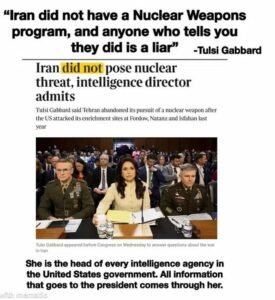
But for some reason, our current leadership has ignored (and continues to ignore) the fact that our top intelligence agencies documented that Iran did NOT pose a nuclear threat. (see below)
As a result, they have turned the Strait of Hormuz into the most expensive toll booth in the world AND a major financial weapon… by severely limiting the passage through one of the world’s most important energy corridors.
And now many Asian countries have already moved to ration fuel or warn of shortages when supply is disrupted.
Adding gasoline (pun intended) to this inferno, if this conflict drags on, those shortages could spread fast.
Printing Dollars…Not Oil
Regardless of how you want to spin it, the Central Banksters will default (as they always do) to printing more dollars.
And that’s when it gets really dicey.
Because if this energy shock unfolds, oil doesn’t just rise a little. It could spike violently.
It’s possible oil races toward $200 a barrel… and then stabilizes well above $100 for much longer than Wall Street expects.
And that would hit the financial system like a wrecking ball.
Think…2008 on a much larger scale.
That is why this crisis has the potential to spiral into something much bigger than a routine market correction.
It could trigger margin calls, derivatives blowups, liquidity shortages, and defaults across the global financial system.