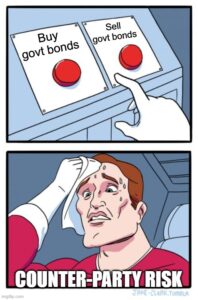
If you don’t know what counter-party risk is, here’s a short description: In any trade/investment involving two or more parties, the risk to the buyer is whether the “counter-party” can pay up.
It seems simple enough but have you ever considered that the stocks and bonds you own may not be able to give you your money back when it’s crunch time?
It’s usually not the case for most major corporations (with assets like buildings, inventory, manufacturing plants, etc.) who get into financial problems.
However, when a push comes to a shove, all you really own is a piece of paper that represents a promise to pay you whatever the “Market Price” * of that paper is worth.
(* Note: Market price does not mean you get your money back. It simply means whatever the current market is willing to pay for that particular asset. A classic example is when you own bonds and interest rates are rising. You may have a $10,000 bond but because of interest rates rising it may only be worth $8,000.)
Don’t worry, we’re not saying stocks or bonds are worthless. We’re trying to get you to understand how a counter-party can default on their promise leaving you holding the bag.